Latest Post/s
 Like Us On FB / Follow Me On Twitter.

Tuesday, October 13, 2015

The Empty God - Charles T. Buntin

A Biblical and Theological 
Answer to the False Doctrine of Kenosis

Introduction

An increasingly prevalent teaching in evangelical circles, particularly in charismatic circles, is the doctrine of Kenosis. This false teaching is drawn from impure wells, it is dangerous because of the other false doctrines it leads to, and it flies in the face of the heart of Christian teaching. What is it? The doctrine teaches that the Messiah, in order to assume the form of a servant and become incarnate (into human flesh), had to give up some, several, or even all the powers and attributes of God and "live as a mere man." The advocates of this heresy, in an effort to assume an orthodox posture, try to say that the Son somehow "remains God," though He has given up all parts of that being. This teaching, which denies so much of the heart of the orthodox faith, comes from the misinterpretation and misconstruction of one Greek word.

This word, and the doctrine it describes, refer to the deep, mysterious, but vitally important passage of Philippians 2:5-8, and especially in verse 7, where it says Christ "made himself of no reputation," or "emptied himself." The word in the original is ekenosen, from the root word kenoo, which can mean "to empty." The other references to the word are Romans 4:14, where the meaning is "made void," 1 Corinthians 1:17, where it means "of none effect," 1 Corinthians 9:15, where it means "make void," and 2 Corinthians 9:3, where it means "to be in vain." These references all refer to abstract principles, such as faith, preaching, or boasting--none of them refer to a person, or even to an object. Therefore, the use of the word as it is used in Philippians 2:7 is unique. The question, which shall be repeated later is "of what did Christ empty Himself?" The teachers of Kenosis say that what Christ did was to "empty Himself of all power."


The doctrinal area in which we are dealing is not academic, it involves the very heart and center of our faith. It is also not just a matter for scholars, but is for all of us. Kenotic teaching has become prominent in charismatic circles, and is the basis for much of what they promulgate. Indeed, much of the weird theology that surrounds the so-called "faith" movement is based on a Kenotic understanding of the incarnation, combined with a new-age-like leap of logic that says that since Jesus left His powers and attributes behind and lived as a mere man, we born-again believers are ". . . just as much an Incarnation of God as Jesus was" (Kenneth Copeland)

In another leap of logic, these teachers move then to the Mormon-like doctrine of apotheosis (we are little Gods). This trend so concerned Walter Martin that the last thing he wrote before going home to be with the Lord was a contribution to a book refuting these theological trends among TV evangelists.1 This paper on Kenosis is not a detailed analysis, but is instead an expanded outline with footnotes, covering these major areas:

The Doctrine of Kenosis This part of the paper includes reference material that traces this view to the 19th-century German liberal theologians that first promulgated the Kenotic teaching, and compares it with modern Kenotic teaching.
The orthodox position on Christ's humiliation. Includes quotations from noted Evangelical Scholars on the subject.

A Critical Refutation of the Kenosis doctrine.
An alternative method of handling the "problem verses" without deviating from orthodox Christology.

I. The Doctrine of Kenosis

A. Classic Kenotic Teaching

(1) "About the middle of the nineteenth century a new form of Christology made its appearance in the Kenotic theories."2 This is how Berkhof introduces the subject. He then delineates three forms of Kenotic teaching--the first, and least offensive, seems to fit the general view: "Thomasius distinguishes between the absolute and essential attributes of God . . . and His relative attributes, which are not essential to the Godhead, such as omnipotence, omnipresence, and omniscience; and maintains that the Logos while retaining His divine self-consciousness, laid the latter aside, in order to take unto Himself veritable human nature."3

(2) "The essence of the original kenotic view is stated clearly by J. M. Creed. 'The Divine Logos by His Incarnation divested Himself of His divine attributes of omniscience and omnipotence, so that in His incarnate life the divine Person is revealed and solely revealed through a human consciousness.'"4

(3) Charles Hodge classes this view under Modern Forms of the Doctrine [Christology], and includes it under a class of doctrines called Theistical Christology taught by various German theological liberals of that era.5 One form of the view is as follows. "...that the Eternal Logos, by a process of self-limitation, divested Himself of all his divine attributes. He ceased to be omnipresent, omniscient, and omnipotent. He reduced Himself, so to speak, to the dimensions of a man."6

B. Comparison with the view of Kenneth Copeland (as a representative of the "Faith Message" school of thought).

This seems to be the general view of the entire "faith message" school of thought, and it is becoming prominent in other charismatic circles as well.

(1) "Jesus hadn't come to earth as God; He'd come as a man. He'd laid aside His divine power and had taken on the form of a human being--with all its limitations."7

(2) "They [orthodox Christians] mistakenly believe that Jesus was able to work wonders, to perform miracles, and to live above sin because He had divine power that we don't have...They don't realize that when Jesus came to earth, He voluntarily gave up that advantage [deity] living His life here not as God, but as a man. He had no innate supernatural powers. He had no ability to perform miracles until after He was anointed by the Holy Spirit... He ministered as a man anointed by the Holy Spirit."8

C. General Comment

The writer of this paper has encountered this teaching in other theological circles, and in at least one other prominent tele-evangelist who is not from the "faith message" camp.

II. A Positive Affirmation, from Scripture, of the Orthodox Position on Christ's Humiliation in Relation to Philippians 2:5-11.

Includes quotations from noted Evangelical Scholars on the subject.

A. The self-emptying of Christ was mainly an emptying of the external trappings and Glory of Deity.

The context of Phil. 2:5-11 is that Christ emptied Himself by taking on the form of a servant. Indeed, the overall issue, from 2:1 through the end of verse 15, is on various forms of outward expression, Christ being the example for the life of the saints in Philippi.

(1) Paul was stressing to the Philippians that they should be self-sacrificing, and should not have personal glory in mind as they live their life. Then, he used the Incarnation as an example. (2:1-5)

(2) Christ, says Paul, was in the form (morphe, an outward expression of an inward reality) of God, and did not consider this Glory, this expression of equality with the Father something to be grasped, or held on to (see John 17:1-5, 24).

(3) Most modern translations say in verse 7 "emptied Himself", but the King James and the New King James read, "made Himself of no reputation." About this difference, one evangelical scholar wrote "The A.V., while not an exact translation, goes far to express the act of the Lord."9 ( In this quote, A.V. stands for Authorized Version, or King James). Then it says, "taking the form of a servant." As we have been talking about outward expressions, vainglory, outward form, etc., and as that is the subject from here through verse 15, the plain sense of scripture here is that Christ's self-emptying was of the outward glory and majesty of Godhood, and that He accomplished that action by taking the form of a servant. This, of course, is what Paul is asking the Philippians to do. Context is vital here--Paul is not telling the Philippians to lay aside, discard, or disregard their natural abilities and talents, (attributes and powers), he is telling them to submit them to the will of God and the good of the whole church.

a. Possibly because of the negative theological background for it, B.B. Warfield went so far as to call the literal translation of kenoo as "emptied Himself" a "mistranslation."10

b. "Nothing in this passage teaches that the Eternal Word (John 1.1) emptied Himself of either His divine nature or His attributes, but only the outward and visible manifestation of the Godhead."11

c. "He emptied, stripped Himself if the insignia of Majesty"12 (Emphasis added)

d. "When occasion demanded, He exercised His divine attributes."13

(4) Verses 8-11 continue the thought--Christ is "...found in appearance as a man...", and continued His voluntary humiliation through to the Cross, then is exalted by the Father (as He discussed with the Father in John 17).

(5) Other Scriptural references that establish the same principal:

a. John 1:1-14. After laying out His perfections, [(1) "The Word was God"--Deity; (2) "He was in the beginning with God," Eternity; (3) "All things were made through Him..." Creator; (4) "In Him was life..." Self Existence;] John says "and the Word became flesh." It is not that God the Son gave up anything, but that He added something--He took humanity to Himself.

b. 2 Cor 8:9 "For you know the grace of our Lord Jesus Christ, that though He was rich, yet for your sakes He became poor, that you through His poverty might become rich." He gave up the external glories of His riches, but did He really give up ownership? No--in His earthly ministry, He claimed to be Lord of the Sabbath, and exercised dominion over natural phenomena, disease and demonic forces, and even demonstrated His possession of the power of life and death. His poverty did not consist as much in what He gave up (for He still retained title to it) as in what He took on--our nature.

c. 2 Cor 5:21 "For He made Him who knew no sin to be sin for us, that we might become the righteousness of God in Him." In His act of atonement, did He give up His own essential Holiness? No, again, it was not that He gave up anything, it was that He added something--He took our sins upon Himself.

B. Do the Scriptures bear out that He possessed the attributes and powers of deity while on earth?

The first, and most obvious reference is His personal conversation with the Father in John 17--He asks (in a "man to man, equal to equal" way) for the return of His Glory. He never mentions the return of His power or attributes--because He still retained them!

(1) Omniscience--John 11:11-14 ("...when Jesus was fifty miles away...")14 John 2:24-25, 6:64, 70-71. As for the instances when He seems to be claiming ignorance, they have to do with Him speaking from His humanity, and taking our place, and involve a complete understanding of the orthodox teaching concerning the relationship between the Divine and Human in Christ, which will be discussed in section IV.

(2) Omnipotence: (demonstrated most vividly in the power over life and death) John 10:17-18, 5:21-23, Luke 7:14, John 11:43-44, Mat 28:18-20, John 18:5-6.

(3) Omnipresence: Matt 18:20, John 1:48 (Ps 139, Gen 16:13), John 3:13 (MAJ . . . Text)

(4) Providence: Heb 1:1-3--Note that "upholding all things" was predicated of Him in the context of His earthly ministry of declaring God's truth, and before His atonement, resurrection, and exaltation. Col. 1:17--"In Him all things consist [hold together]" The universe is upheld by His word of power--He holds it together--that is an essential part of who He is. There is no intimation anywhere in scripture that He gave up this function upon Incarnation.

(5) Sovereignty: Mk 2:28, Mat 11:27, John 17:2. John 3:35
C. Having looked at the issue piecemeal, we can now conclude it with the powerful testimony of the book of Colossians.

(1) Paul says that in Christ ". . .are hidden all the treasures of wisdom and knowledge," (2:3) and ". . . Beware lest anyone cheat you through philosophy and empty deceit, according to the tradition of men, according to the basic principles of the world, and not according to Christ. For in Him dwells all the fullness of the Godhead bodily." (2:8-9, emphasis added)

(2) The argument might be (and has been) made that those verses apply to Christ in His exaltation, and not in His humiliation. First, that logic leans to the Gnostic idea of "progression," that the Logos after His exaltation was materially and essentially different (and improved) as a person from what He was during His humiliation. This is the very idea that Paul was fighting in the book of Colossians! The clincher, however, lies in the earlier verses in chapter 1: ". . . It pleased the Father that in Him all the fullness should dwell, and by Him to reconcile all things to Himself...through the blood of His cross." (1:19-20) All the fullness of God dwelt in Him bodily during His earthly ministry!

III. A Critical Refutation, from Scripture and from Evangelical Scholars,of the things implied and taught by the Kenosis Doctrine.

The theologians who crafted Kenotic doctrine were trying to deal with two problems. The first problem was in how to deal with those texts of scripture (as used by the cults) which seem to indicate that Christ was less than fully God, yet do justice to the obvious Biblical teaching that He was "Very God of Very God." The second problem was posed by their understanding that He lived His life in submission to the will of the Father, and largely as a man with a full indwelling of the Holy Spirit. They could not reconcile that in their minds with His full deity. The problem with these teachers was that they were theological liberals--they did not accept the verbal, plenary, inspiration of the Bible. Because of this, they crafted an erroneous philosophical theological answer, and ignored the fact that the problems were already solved by scripture, and had been fully worked out by the teachers and leaders of the early church during the period from A.D. 250-451. In their effort to improve on the Council of Chalcedon, they created many more problems than those they sought to solve--and did not really solve what they had originally perceived to be problems in the orthodox faith.

A. The philosophical and theological bases for the Doctrine of Kenosis are highly suspect.

The thought process began with an incorrect concept of God as the Absolute and Almighty God.

(1) Thomasius of Erlangen, one of the first and leading proponents, ". . . distinguishes between the absolute and essential attributes of God," and taught that omniscience, omnipresence, and omnipotence ". . . are not essential to the Godhead..."15

This is patently ridiculous, and there is absolutely no Biblical basis for classing the three "omni" attributes as non-essential for Deity. Philosophical theologians may find a way to make this add up, but in the words of one of this century's great Bible teachers, ". . .There is no other possible alternative between an absolutely supreme God, and no God at all."16 It is impossible to conceive of any being worthy of the title of I AM who does not possess the essential attributes continually posited to God by the Bible. The Bible never mentions God as anything but absolute. The three attributes in question, absolute Knowledge, Potency, and Presence, are foundational to who Jehovah is. The sarcastic charges made by Jehovah against false "gods" usually center in their ignorance, impotence, and immobility (Deut 4:28, Is 45:20, Jer. 10:5, 15). In comparison to idols, Jeremiah says "He who is the Portion of Jacob is not like these, for He is the Maker of all things...the LORD Almighty is His name." (10:16) Indeed, if one reads the awesome passages like Is 40, Job 38:1-42:6, Ps 90, Rom 11:33-36, etc., as well as the countless other verses and passages that extol and marvel at the greatness of the Almighty Jehovah, there can be no other conclusion but that God is Absolute. There is no Biblical way that the Son could give up his divine knowledge, potency, and presence, and remain "in essence" God. The distinction is strictly one of human philosophy. Concerning Kenosis, Charles Hodge, the leading American evangelical scholar of the last century, wrote

"The theory in question is inconsistent with the clear doctrine both of revealed and natural religion concerning the nature of God. He is a Spirit, infinite, eternal, and immutable. any theory, therefore, which assumes that God lays aside His omnipotence, omniscience, and omnipresence, and becomes as feeble, ignorant, and circumscribed as an infant, contradicts the first principle of all religion..."17

It must be pointed out here that Hodge fully accepted the doctrine of the incarnation, that God came in the flesh, as an infant and a man. However, he saw it in the light of historic Christology, as discussed in section IV, that while all of that was true, Christ was not confined to that form of a servant, and was not limited by it, except that He willingly gave up the exercise of His Glory, and sometimes chose not to use His other powers, though He retained them fully.

Berkhof shines more light on the philosophical antecedents of Kenosis when he writes: "The theory is based on the pantheistic conception that God and man are not so absolutely different but that the one can be transformed into the other. The Hegelian idea of becoming is applied to God, and the absolute line of demarcation is obliterated."18 The theologians who concocted this heresy were German scholars steeped in the insidious philosophy of Hegel, the forerunner of both communism and fascism.

B. The vital doctrine of Immutability is completely destroyed by Kenotic teaching.

(Cf. Malachi 3:6; James 1:17; Hebrews 13:8)

(1) Biblically, there was no essential change of the nature of the Second Person of the Trinity in His Incarnation, because He did not lose the essential attributes of deity, He took on human flesh and a human nature. In His own essence, He did not change (Heb 13:8).

(2) Beyond its effect on the immutability of the Son, it would destroy the integrity of the Triune God if He ceased to be fully and totally the Absolute God during His Incarnation, . "It means a virtual destruction of the Trinity, and therefore takes away our very God. The humanized Son, self-emptied of His divine attributes, could no longer be a divine subsistence in the Trinitarian life."19

C. If the God-Man who died on the cross was not both fully God and fully Man, then the integrity of the atonement is destroyed.

The Blood that redeemed the Church was the "Blood of God." Acts 20:28 If He was any less than God, then His blood sacrifice was not infinitely powerful and able to redeem all who believe in every age.

IV. An alternative method of handling the "problem verses" without deviating from orthodox Christology.

There are three Biblical concepts which are at the heart of this method: (A) Understanding the biblical doctrine of the two natures of Christ. (B) Understanding His role as our Kinsman-Redeemer and substitute, and (C) Understanding and admitting the existence of the Biblical concept of "mystery"--the fact that there are some things which must be just believed, because there is no way to understand them.

A. Understanding the biblical doctrine of the two natures of Christ.

The Trinitarian Controversy (A.D. 320-381) led directly into a great controversy over the Nature of Christ's Person. Understanding the doctrinal dimensions of this fight, and understanding the conclusions reached by the church are vital to understanding how to combat the cults in this area, since the cults of today are merely the heresies of yesterday refried. During this period of Church History, there were many evil things done in the name of one doctrine or another, yet miraculously, truth triumphed.

(1) As the early church wrestled with understanding the Biblical teaching about Christ, there were three views that became most prominent. I will try to illustrate these views by assigning different ways of writing the term , "God-Man" to each view.

a. The Monophysites taught that Christ was the God-man, that is, He was not fully God and Fully man, but a third entity which was a fusion of the two natures (The Kenotic teaching is closest to this among the early heresies.) This heresy was basically a leftover of the Origenistic tendencies of Arianism, and grew strongest in the areas that had been strongest for the Arian view. The battle cry of this party was that Mary was the Theotokos, or Mother of God. The Monophysites carried this erroneous teaching (which survived, though without the Christological conclusions attached) to extremes, and made of Christ a new category of being, with one nature, will, and personality, each a fusion of God and Man.20

b. The Nestorians taught that Christ was the God, Man with two natures so separate as to be a split personality. This teaching developed because of the objections of the church and theological school of Antioch to the growing cult of Mary among monophysite believers.21

c. The orthodox view, which was approved by the Council of Chalcedon in 451, and which has been accepted and proven to be fully Biblical by evangelical Christians since the Reformation, was that Christ was the God-Man, fully God and fully Man, one person with two unmixed natures.22

(1) The important key concept in the orthodox doctrine is whatever Christ did, He did as a whole person. For instance, when His human body was beaten, tortured, and died, He suffered as a whole person, so that though God cannot be killed, it can be said that God Died for Our Sins.23

(2) Because of the Truth of the two natures, we can Biblically say:24

a. Christ is infinite OR Christ is finite. He existed from all eternity OR He was born in Bethlehem

b. He was omniscient OR He was limited in knowledge

c. He is David's Lord YET David's son

d. He is the Ancient of Days YET He was born as an infant

e. He is God over all YET He is the son of Mary

f. He upholds all things YET He is weary with His journey

g. Without Him was nothing made that was made YET He can do nothing without the Father

h. His natural form is the form of God YET He takes on Him the form of a servant

i. He is the same yesterday, today, and forever, YET He increases in stature

j. He Knows the Father perfectly YET He increases in wisdom

k. In His own name, he gives a new and more perfect law and proclaims Himself Lord of the Sabbath and greater than the temple, YET He is born under the law and is subject to the law

l. He is the Prince of Peace YET His souls is troubled

m. He is King of Kings and Lord of Lords, YET He goes to death at the order of a Roman governor

n. He is with us always unto the end of the world, YET The disciples saw Him being received into heaven out of their sight.

B. Understanding His role as our Kinsman-Redeemer and substitute.

Why was is necessary for the Redeemer to be the God-Man? Why is the doctrine of the two natures of Christ so important? The answers lie in God's law of the goel, or Kinsman-Redeemer, (Lev 25) illustrated beautifully by the historical story of Ruth. Scofield summarizes the principle concisely in his note on Is 59:20.25

(1) The kinsman redemption was of persons, and an inheritance (Lev 25:48, 25:25; Gal 4:5; Eph 1:7, 11, 14.).

(2) The Redeemer must be a kinsman (Lev 25:48-49; Ruth 3:12-13; Gal 4:4, Heb 2:14-15).

(3) The Redeemer must be able to redeem (Ruth 4:4-6; Jer. 50:34; John 10:11, 18).

(4) Redemption is effected by the goel (Kinsman-Redeemer) paying the just demand in full (Lev 25:27; 1 Pet 1:18-19; Gal 3:13).

(5) Therefore, what we see as Christ's humiliation was done as our goel, our redeemer, our substitute. When He was living, acting, speaking, suffering, denying full knowledge of events, claiming total dependence on the Spirit, etc. as a man, he was doing these things out of His human nature, and in our place. Yet, because He was also God, He could pay the whole price--he lived, acted, spoke, and suffered as no other man ever had or ever could.

C. Understanding and admitting the existence of the Biblical concept of "mystery."

There are some things which must be just believed, because there is no way to understand them.

(1) God is unsearchable (Eccl. 3:11, Is 40:28, Rom 11:33-36, Job 5:9, Job 11:7)

(2) There are many mysteries in the gospel (1 Tim 3:16, Eph 5:25, 1 Cor 15:51)

(3) Christ Himself is a mystery (Rom 16:25, 1 Cor 2:7, Eph 1:9, 3:4, 3:9, Col. 1:27)

D. The three core concepts related above should help us understand how Christ lived His life on earth.

He lived in appearance as a man (Isaiah 53:3, Phil. 2:8), and submitted His will to the Father, and lived His life as a man anointed by the Spirit (Luke 4:16-21). Yet, He retained all His powers, and demonstrated His abilities often as a vindication of His messiahship and proof of His authority (Mk 2:1-12). In the mysterious verse John 5:17, ". . . My Father has been working until now, and I have been working," we are given a clue that He did many of His works "in His own right," though they were always in accordance with the will of the Father. On one occasion, He even lifted the veil of His flesh, took off His servant nature, so His three closest disciples could see Him as He really was (Mat 17:2). On another occasion, He "lifted the hem of His veil a bit"--when they came to arrest Him, He said "I AM," and they all fell down (John 18:4-6).

If we were to make an illustration of Jesus as if He were a policeman going under cover in a bad neighborhood, the Kenosis doctrine has the policeman leaving his weapons at home, along with his badge and other symbols of authority. He can call on headquarters for help, but he himself is helpless and defenseless. The orthodox teaching has the policeman himself as a "lethal weapon", he is a martial arts expert who can kill with a blow--he is skilled on the level that he can reach within a man's chest and pull out his still-beating heart--he can defeat multiple opponents. He can leave His I.D. , badge, uniform, etc., behind just like cop number one, but he cannot cease to be the walking weapon that he is. He looks normal, he appears as helpless as the first policeman, but he has the ability within himself to defend himself. He might choose to call for help; he might even choose to allow himself to be shackled, hurt or killed for the good of the mission--but he has the ability within himself to defeat his enemies. Raise that illustration, and the powers of the second policeman to infinity, and the illustration shows the difference in the two doctrines.

One of the beauties and glorious mysteries of the cross is that He who hung there was at that moment sustaining the universe--the very breath of the Roman soldiers was in His grip. He could have destroyed the Roman empire with a wink, with a thought, but He voluntarily restrained His great power, submitted to the plan He and the Father had agreed to before the world was made, and laid down His life. The entire Trinity was involved here--The Father pouring out His wrath , the Son Propitiating the wrath (Rom 1:18, 3:25-2, 5:8-11), and the Spirit involved in a way the Bible does not specify (Heb 9:14). This is a great mystery, but it cannot be solved by reducing the Son to something not quite God.

E. It is from applying the core concepts above that we can construct meaningful and orthodox answers to the questions of those who refuse to believe in the God of the Bible.

The answer is not to deviate from Truth ourselves through less-than-precise theology--it is to present the whole Truth unvarnished and uncut.

J.I. Packer, the dean of living evangelical theologians, completely rejects the doctrine of Kenosis, as illustrated in his book Knowing God. He says plainly, "The Kenosis theory will not stand."26 I encourage the reader, to see what this Christian leader says about the subject. I hope that my study will be of help, and if you have been infected with this false doctrine I pray you will seriously consider modifying your views in this vital area.


1 Walter Martin's last published writing was a refutation of apotheosis in the book The Agony of Deceit , (Moody Press, 1990). Included in that same book is an article by Dr. Rod Rosenbladt entitled Who Do TV Preachers Say That I Am?, which refutes, among other things, the teaching of Kenosis.
2 L. Berkhof, Systematic Theology, (Wm B Eerdmans Publishing Company, 1940) pg 327.
3 Ibid.
4 Ralph P. Martin, Kenosis, The New Bible Dictionary (Wm B Eerdmans Publishing Company, 1973), pg 6.89
5 Charles Hodge, Systematic Theology vol. II/III, (Reprint by Wm B Eerdmans Publishing Company, 1977) pp 428-440.
6 Dr. Rod Rosenbladt, Who Do TV Preachers Say That I Am? The Agony of Deceit, (Moody Press, 1990) pp 114-115.
7 Ibid.
8 Ibid.
9 W. E. Vine, (Edited by F. F. Bruce) Vine's Expository Dictionary of Old and New Testament Words (Fleming H. Revell Company, 1981) N. T. Vol. 2, pg 25.
10 Berkhof, op. cit. pg 328.
11 C. I. Scofied, The Scofield Reference Bible (Oxford University Press, 1917), pg 1258.
12 Lightfoot, cited by Scofield, ibid.
13 Moorehead, cited by Scofield, ibid.
14 Scofield, op. cit. pg 1145.
15 Berkhof, op. cit. 327.
16 A. W. Pink, The Attributes of God (Baker Book House, 1975) pg 29.
17 Hodge, op cit, pg 439.
18 Berkhof, op. cit. pg 328.
19 Ibid. 329
20 Phillip Schaff, History of the Christian Church, Vol. III (Wm B Eerdmans Publishing Company, 1977) p705-783.
21 Ibid
22 Loraine Boettner, Studies in Theology, (The Presbyterian and Reformed Publishing Company, 1973) pp 195-203.
23 Hodge, op. cit.
24 Boettner, op. cit. 197.
25 Scofield, op. cit. pg 765.
26 J. I. Packer, Knowing God, (InterVarsity Press, 1973) pg. 52.
Related Topics: Christology, Theology Proper (God)

SOURCE: https://bible.org/article/empty-god

Saturday, October 10, 2015

STOLEN GOLD and the VATICAN NAZIS.


The Vatican Bank and Nazi Gold

The Vatican Bank and Nazi Gold: A Scandal Unsolved

In 2013, Pope Francis publicly stated he'd get to the bottom of several scandals plaguing the Catholic Church.

Despite the pontiff's investigation, one scandal remains shrouded in mystery: that of the Vatican Bank and Nazi gold.

You see, some bits of evidence suggest the Vatican collaborated with Nazi party members responsible for plundering Jewish citizens' gold during World War II. But other evidence casts doubt on the extent of the Catholic Church's direct participation in Nazi activities. The Holy See has long denied any sort of affiliation between the Church and the Third Reich ever existed. Still, limited independent research into a possible connection has been conducted by several agencies, including the U.S. Treasury.

"During and after World War II, was the Vatican bank a witting or unwitting accomplice of Nazi collaborators known as Ustashi who made their way from a seminary in Rome to safe havens in South America?" The National Catholic Review asked July 15. "Did the Vatican bank profit as a result of payments received from these Nazi collaborators who were known as the Ustashi? If we were to follow the Ustashi money, where would the trail lead?"

There's limited evidence with which to answer these questions. We'll let you decide for yourself…

The Vatican and Nazi Gold: Evidence of Church Involved

The Ustasha, an organization also known as the "Nazi Puppet Regime," operated in Yugoslavia from 1929-1945. It functioned as a fascist terrorist movement that supported Nazi and Italian forces.

During World War II, Ustashi military members gathered an estimated 500,000 Serbs, Jews, and Gypsies and demanded 1,000 kilograms of gold from each, wrote ABC News on Feb. 15, 2013. They were told the money would prevent their murders. But once the funds were handed over, the groups were sent to concentration camps anyway, where most of them died.

While the Ustasha collaborated with German forces to fight in occupied Yugoslavia, the organization likewise operated closely with the Croatian Catholic Church, helping priests force Orthodox Serbs to convert. Members of the Franciscan sect also distributed anti-Jewish propaganda with the aid and protection of the "Nazi Puppet Regime."

The clergy's involvement was eventually exposed. A trial in 1946 resulted in the conviction of six Ustasha priests total, including former Franciscan Miroslav Filipovic-Majstorovic – the overseer of a concentration camp where the Ustashas killed hundreds of thousands of Jewish Serbs.

Though Fr. Filipovic-Majstorovic oversaw one of the death camps, it was Fr. Krunoslav Draganovic who had directed the entire murderous priesthood. The Franciscan was also a senior official of the Ustasha committee. Foreseeing defeat near the end of the war, in 1943, the Ustasha made arrangements with the Vatican for Draganovic to be sent to Rome. There he served at a clandestine Ustasha hub disguised as a seminary.

Draganovic and other collaborators helped procure the means and support for a number of fellow Ustasha war criminals attempting to escape persecution. They even managed to forge Red Cross passports. Eventually, through an underground railroad of sympathetic priests known as "the Ratline," several members of the Ustasha escaped to neutral countries (primarily Spain and Argentina).

Virtually the entire "puppet regime's" leadership went free – largely due to help from the Vatican.

The Vatican and Nazi Gold: A Mysterious Document Surfaces

When Germany surrendered on May 7, 1945, 288 kilograms of gold were removed from the Croatian National Bank and state treasuries. Some of that landed in Draganovic's hands. Called the "Golden Priest," he continued to dole out funds to Croatian refugees from his new home in Rome. He was never officially charged for war crimes and returned to Yugoslavia after the war. He died in 1983 in Sarajevo.

Rumors swirled for years that the Vatican Bank harbored Croatian plunder. But it wasn't until new evidence surfaced in 1997 that the controversy picked up steam again…

On July 23, 1997, The L.A. Times revealed that documentarians from the television network A&E had discovered proof in the Vatican Bank's archives of a Nazi gold scandal. Specifically, they uncovered a memo amid a trove of already declassified material that totaled over a million pages. The documentarians were the first to thoroughly sift through the humongous cache of information.

The memo had been composed by former U.S. Treasury Department field investigator Emerson Bigelow. After the Second World War, Bigelow conducted several investigations throughout Europe. This is when he purportedly connected with a viable source that could link the Vatican Bank directly to Nazi gold. Bigelow outlined all of this information in his memo that, for an unknown reason, was never received.


The Vatican and Nazi Gold: The People vs. the Church

When survivors of the Ustasha regime learned of the documentarians' investigation, they formally requested Bigelow's report be released under the Freedom of Information Act in 1997. The survivors filed a lawsuit against the Vatican Bank based on Bigelow's memo in 1999.

According to Concordatwatch.com, the case was originally brought before a California court in November 1999. Four years later, Vatican lawyers successfully argued the case was outside the jurisdiction of U.S. courts. The previous ruling was overturned.

Then in 2005, an appeals court overturned that judgement and allowed some of the claims – primarily those for restitution – to proceed. However, on Dec. 30, 2009, the Ninth Circuit Court of Appeals in San Francisco re-upheld the original lower court ruling. The decision stated the Vatican Bank was immune from the lawsuit and further prosecution under the 1976 Foreign Sovereign Immunities Act.

To this day, the Vatican's archives – likely the only source that could directly tie the Vatican Bank with Nazi gold – have remained sealed. (SOURCE: MoneyMorning.com)


Hitler's Gold - You Will Not Believe How Much They Stole


Mystery of the 'Werewolf' unit's lost horde: How a Nazi ghost train packed with treasures and a gold bar found in a lake at Hitler's hideaway are shining spotlight on the race to find $30BILLION fortune hidden by the Third Reich

Train packed with Nazi treasures, gems, money, gems and gold reportedly uncovered in a mountain in Poland
£12,000 gold bar was discovered in a lake near Hitler's mountain hideaway 
Discovery fuelling the pursuit of up to £20billion worth of missing treasure
Includes silverware the Nazis stole from Jews and gold from bank vaults
At least seven people have died looking for treasure in freezing LakeToplitz


Seventy years since the Third Reich was consumed in blood and fire the hunt is on for the loot that the Nazis left behind.

The reported discovery of a legendary Nazi 'ghost' train packed with gold and money by two treasure hunters hidden in a long-forgotten tunnel in the Polish mountains will only serve to fuel what has become an obsession for many Germans.

The hunters claim they have uncovered the train, packed with guns and gems, that became the stuff of local legend as the Nazis hid their treasures from the advancing Soviet Red Army.

Legend has it that the Germans hid their treasures as insurance policies to help fleeing war criminals escape and set up new lives at the end of the Second World War. 
Added to the intrigue is the recent find of a £12,000 gold bar in a lake near Hitler's mountain hideaway in Berchtesgaden, high up in the Bavarian mountains.

The ingot in question was not from the Nazi era, but that matters little to the fortune hunters who now access state-of-the-art equipment in their quest for the billions of pounds worth of art, gold and jewellery the regime's henchmen secreted away in the dying days of the war.
Some of it was meant to finance the escape routes of war criminals: other caches were intended to fund 'Werewolf' resistance units intended to carry out guerilla warfare against the occupying Allies until a new Fourth Reich could rise again.

Now unfavourable bank interest rates combined with websites stoking fantasies of striking it rich have set Teutonic Indiana von Jones' upon the quest of finding a chunk of the estimated $30billion-worth of missing treasure.

Read more: Pls Click HERE.


Earlier find: General Patton's third army discovered 100 tons of Nazi gold hidden in a salt mine near mockers, southwest of Gotha in 1945


Polish Government Confirms Discovery Of Nazi "Gold Train", Warns It May Be Booby-Trapped

Last weekend we reported that in the past month two men, a Pole and German, claimed to have discovered the legendary Nazi "gold train" - a 150 meter long German train alleged to be full of gold, gems and weapons, which disappeared just before the end of World War II - in the proximity of the Polish town of Walbrzych, close to where the Nazi are said to have loaded up the train with valuables for its final voyage in the town of Wroclaw, just as the Soviet forces approached in 1945.


As we detailed, the train is said to have been entombed in the vast tunnel labyrinth located close to Ksiaz castle, which served as Nazi headquarters during World War II...

... and specifically, was said to be located at the foot of the Sowa mountain, in the woods three miles outside the town of Walbrych.


The "gold train" is said to be located under this hill
While many were skeptical that the mystical Nazi treasure train had been finally discovered after many years of searching, an official update last Friday by the Polish government suggested that that may indeed be the case. As the Mail reported on Friday, a representative of the Polish culture ministry, Poland’s National Heritage and Conservation Officer Piotr Zuchowski, said that the man who helped hide the train had revealed its location shortly before he died, and that proof of the train has been observed on radar.

Zuchowski added that "Information about where this train is and what its contents are were revealed on the deathbed of a person who had knowledge of the secret of this train.' He added that Polish authorities had now seen evidence of the train’s existence in a picture taken using a ground-penetrating radar. He said the image - albeit blurred - showed the shape of a train platform and cannons.


Piotr Zuchowski, Poland’s National Heritage and Conservation Officer, confirmed the 'unprecedented' find
Mr Zuchowski said the find was 'unprecedented', adding: 'We do not know what is inside the train. 'Probably military equipment but also possibly jewellery, works of art and archive documents.

'Armored trains from this period were used to carry extremely valuable items and this is an armored train, it is a big clue.' He said authorities were now '99 percent sure the train exists' and whatever is on it will be returned to the rightful owners, if they can be found. 'We will be 100 per cent sure only when we find the train,' Mr Zuchowski added.


The train found in the mountains is an 'armored train' which looks similar to the one pictured
Mr Zuchowski told reporters that the train was about 100 metres long but added: 'It is not possible to disclose the exact location of where the train can be found. Still, he noted cryptically that "The local government in Walbrzych knows where it is."

He explained it is hidden along a 4km stretch of track on the Wroclaw-Walbrzych line.

Mr Zuchowski said the person who claimed he helped load the gold train in 1945 said in a 'deathbed statement' the train is secured with explosives. The official declined to comment further about the man who said this but speculation is now rife that it was a former SS guard or a local Pole who stumbled upon the train before hiding it.

Deputy Mayor of Walbrzych, Zygmunt Nowaczyk told the press: 'The city is full of mysterious stories because of its history. 'Now it is formal information - we have found something.'

Key excerpts from the press conference by the Polish official can be seen on the Euronews clip below:


The confirmation of the discovery unleashed a surge of treasury hunters, and forced the Polish government to warn the population to stop looking because it could be booby-trapped and dangerous. Zuchowski said "foragers" have become active since two people claimed to have discovered the train last week and urged eager fortune-hunters to stop searching, saying they risk injury or death.

Zuchowski adds that "there may be hazardous substances dating from the Second World War in the hidden train, which I'm convinced exists. I am appealing to people to stop any such searches until the end of official procedures leading to the securing of the find. There's a huge probability that the train is booby-trapped.'

If anything, tthese warnings are sure to unleash an even more aggressive wave of seekers now that the train's existience has been confirmed, and the government is actually warning seekers to be careful in their search.

But perhaps what is more interesting is just what the discovery, which would be straight out of an Indiana Jones sequel, will contain, and whether someone already got to the precious cargo over the past 7 decades. The answer should be made public shortly. (Source: ZeroHedge.com )

Friday, October 09, 2015

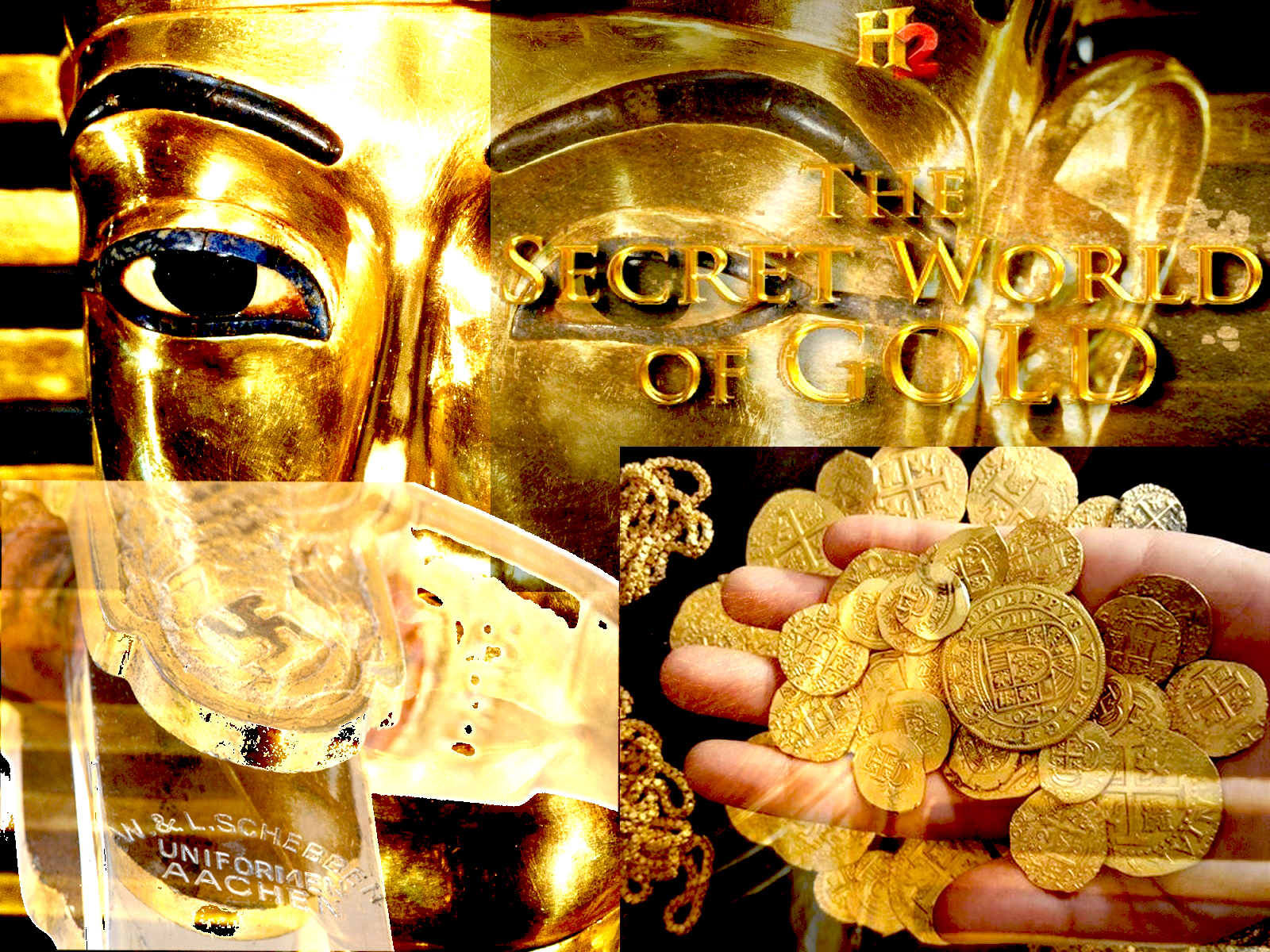
The Secret World of Gold


The Secret World of Gold is a documentary exploring the power and politics of gold, a precious metal with more allure and fascination than any other. Valued for its permanence, beauty and scarcity, people will lie, cheat, steal and kill in the name of gold.


To finance the Third Reich, the Nazis went after the gold of Europe. Allied countries stored their gold offshore to keep it safe. In the first months of the Second World War, the gold of England and France was secretly shipped to vaults in Montreal, Ottawa and New York.

Those ships made it safely to port, but throughout history, many were not so lucky. It is estimated that worldwide, 3 million shipwrecks loaded with treasure lie at the bottom of the ocean. Odyssey Marine, an American company listed on the NASDAQ stock exchange, spends huge amounts of money to search for that gold. But there's always the risk they will have to hand it over to countries claiming ownership.

In recent years, economic uncertainty is giving gold a new lustre in the world of high finance. Whether it's a few gold coins or gold bars stored in one of the many vaults around the world, many investors are taking a shine to gold. But there's not a lot of it. It is said that, even melted down, there would not be enough to fill an Olympic swimming pool (or maybe not - see sidebar).

Some claim that much of the gold held by the Bank of Canada, the Bank of England, the Federal Reserve and Fort Knox is gone — that for every 100 ounces of gold traded, there exists only one ounce of real, physical gold. So, where is the gold — and who really owns it?

Directed by Brian McKenna for Galafilm with CBC-TV.

Saturday, August 29, 2015

The Art of Prophesying, by William Perkins

Book Review: The Art of Prophesying, by William Perkins
William Perkins. The Art of Prophesying; With, The Calling of the Ministry, Rev. ed., Puritan Paperbacks (Edinburgh; Carlisle, PA: Banner of Truth Trust, 1996).


William Perkins (1558-1602) was the first English theologian to gain an international reputation after the Reformation. His works were translated and published throughout Europe. By the end of the sixteenth century in England, his writings began to displace those of John Calvin, Theodore Beza, and Heinrich Bullinger. Because of this, Perkins became known for his powerful preaching, such that he’s remembered for it long after his death.

He served as the preacher at Great St. Andrew’s Church in Cambridge for almost twenty years, from 1584 until his death in 1602. His prominent preaching ministry combined with his vast literary output earned Perkins the honorary title, “the father of Puritanism.” Puritanism as a movement was devoted to placing competent preachers in every pulpit of the Church of England. Competency included right interpretation, plain style, and an ability to apply the text. It was from this foundation that Puritan preaching derived its power.

SUMMARY

While Perkins was certainly not the only proponent of Puritan preaching, he was the first to articulate it in a full-scale treatise on hermeneutics and homiletics. He did this in his classic work, The Art of Prophesying, first published in 1592. By “prophesying,” Perkins meant preaching the Word and public prayer. He used this designation because he saw the pastor—as one who stands between God and the people as he exercised these duties—in the great succession of biblical prophets and apostles. Preaching is the focus of his book, and in 75 small, readable pages, he lays out his method of exposition.

Perkins summarizes preaching this way:

Reading the text clearly from the canonical Scriptures.
Explaining the meaning of the text, once it has been read, in the light of the Scriptures themselves.

Gathering a few profitable points of doctrine from the natural sense of the passage.
If the preacher is suitably gifted, applying the doctrines thus explained to the life and practice of the congregation in straightforward, plain speech. (79)
So, Perkins’ preaching method is threefold: interpretation, analysis, and application. He proclaims, “The Word of God alone is to be preached, in its perfection and inner consistency. Scripture is the exclusive subject of preaching, the only field in which the preacher is to labor” (9). For Perkins, proper interpretation begins with grammar, rhetoric, and logical analysis. He encourages seeking the help of contemporary and ancient orthodox writers, as well as saturating the whole process in prayer. All of this has one goal: to bring out the one full and natural sense of the text.

The means, or key considerations, are the rule of faith—that is, the basics of Christian orthodoxy—the context of the passage, and its comparison with other passages. Analysis or “resolution” means unfolding the passage into its various doctrines. Whether explicit or implicit, these doctrines must be drawn from the genuine meaning of the text. Perhaps the most enduring significance of Perkins’s labor is his emphasis on application—or, as he puts it, “the skill by which the doctrine which has been properly drawn from Scripture is handled in ways which are appropriate to the circumstances of the place and time and to the people in the congregation” (54).

WHY YOU SHOULD READ IT

There are many reasons why pastors today should read The Art of Prophesying. Some I have already mentioned, such as Perkins’ emphasis on Scripture, his rigorous, yet simple, method of its interpretation, and his legacy of faithfulness. Here are few more that I have found uniquely helpful in Perkins’ work.

First, there is great wisdom in Perkins’ practical advice to preachers. He exhorts us to only correct the errors that our congregations are actually threatened by, so as not to create trouble that had not existed. He also urges that the correction of secondary issues be in a friendly manner. A final example of Perkins’ practical guidance is from his insistence on a plain style. He warns about quenching the Spirit through the use of specialized vocabulary, elevated oratory, or Greek references. All these points of instruction are particularly appropriate for those of us in seminary!

Second, Perkins provides an approach for specific and pointed application, which is one of the most difficult aspects of sermon preparation. He breaks the preacher’s audience down into seven categories or spiritual conditions of hearers: ignorant and un-teachable unbelievers, ignorant but teachable unbelievers, knowledgeable but un-humbled unbelievers, humbled unbelievers, believers, backsliders in faith or lifestyle, and mixed congregations of believers and unbelievers. He also draws four varieties of application from 2 Timothy 3:16; teaching and reproof involve informing the mind and recovering it from error, whereas instruction and correction include helping hearers to practically live out their faith in the spheres of family, state, and church so as to move from ungodliness to godliness. Coupled together, these taxonomies create a usable framework for practical application.

Third, Perkins reminds us of the men we must be in order to be effective preachers. I must be a man of prayer, both in preparation for preaching and in the pulpit itself. Further, I must possess holiness of heart and a blameless life. Perkins understands this godliness of the minister to flow from more than biblical understanding, but also “an inward sense and experience of the Word in his heart” (73).

In the context of today’s confusion over preaching, The Art of Prophesying is a welcome reminder of a time-tested approach to evangelical preaching. It was the primary preaching manual in the English-speaking world on both sides of the Atlantic for generations—and for good reason. The perennial issues it addresses makes it surprisingly suited for our own context. The reader almost forgets the work is more than 400 years old. Perkins understood the value of preaching as two-fold: proclaiming and applying the truth. This gathers the elect and drives away the wolves; put differently, it is the means by which God builds his church. Whether one agrees with his particulars or not, this ought to be our vision for preaching even today. Perkins’ offering will at the very least challenge pastors to be relentlessly biblical and to do the hard work of robust application. May Perkins’ closing words express the essence of every preaching ministry today:

“The heart of the matter is this:
Preach one Christ,
by Christ,
to the praise of Christ.

Soli Deo Gloria.”

SOURCE: http://9marks.org/review/book-review-the-art-of-prophesying-by-william-perkins/


I. THE ART OF PROPHECY

"There are two parts to prophecy: preaching the Word and public prayer. For the prophet (that is, the minister of the Word) has only two duties. One is preaching the Word, and the other is praying to God in the name of the people: 'Having ... prophecy, let us prophesy in proportion to our faith' (Rom. 12:6); 'Restore the man's wife, for he is a prophet, and he will pray for you and you shall live' (Gen. 20:7). Notice that in Scripture the word 'prophecy' is used of prayer as well as of preaching: 'The sons of Asaph, of Heman, and of Jeduthun, who should prophesy with harps, stringed instruments, and cymbals' (1 Chron. 25:1); 'The prophets of Baal called on the name of Baal from morning even till noon ... And when midday was past, they prophesied until the time of the offering of the evening sacrifice . . .' (1 Kings 18:26, 29). Thus every prophet's [ask is to speak partly as the voice of God (in preaching), and partly as the voice of the people (in praying): 'If you take out the precious from the vile, You shall be as My mouth' (Jer. 15:19); 'And Ezra blessed the Lord, the great God. Then all the people answered, "Amen, Amen!"' (Neh. 8:6).

Preaching the Word is prophesying in the name and on behalf of Christ. Through preaching those who hear are called into the state of grace, and preserved in it. God has 'given us the ministry of reconciliation ... Now then, we are ambassadors for Christ, as though God were pleading through us; we implore you on Christ's behalf, be reconciled to God' (2 Cor. 5:18, 20); 'God from the beginning chose you for salvation, through sanctification by the Spirit, and belief in the truth, to which He called you by our gospel' (2 Thess. 2:13, 14); 'The gospel is the power of God to salvation for everyone who believes' (Rom. 1:16); 'Where there is no revelation the people cast off restraint' (Prov. 29:18); 'How then shall they call on Him in whom they have not believed? And how shall they believe in Him of whom they have not heard? And how shall they hear without a preacher?' (Rom. 10:14)." - Extracted from THE ART OF PROPHESYING by WILLIAM PERKINS (1558-1602) first published in Latin 1592 and in English 1606. You can read the whole e-book HERE.

Sunday, August 23, 2015

LIFE AND PROSPERITY, DEATH AND DESTRUCTION


In Deuteronomy 30, Moses gives the Bible's first glimpse of the two final destinations of the human race: one leads to life and prosperity, the other to death and destruction. In this session from the 2015 Gospel Coalition National Conference, author and pastor Tim Keller works from Deuteronomy 30 to show our only hope to achieve life and prosperity lies in the gospel. 


In this 47-minute session from the 2015 Gospel Coalition National Conference, Tim Keller works from Deuteronomy 30 to show that our only hope to achieve life and prosperity lies in the gospel. Tim is pastor of Redeemer Presbyterian Church in Manhattan. He is co-founder and vice president of The Gospel Coalition and author of numerous books, including The Reason for God  and Center Church. - Right Now Media.


2015 TGC NATIONAL CONFERENCE -http://resources.thegospelcoalition.org/library/life-and-prosperity-death-and-destruction

Saturday, August 22, 2015

China’s Reforming Churches Mission, Polity, and Ministry in the Next Christendom.

"Even the most conservative analyst must acknowledge China is changing. This nation of 1.35 billion people—20 percent of the earth's population, boasting the world's second-largest economy and largest language group (Mandarin Chinese)—is experiencing not just change, but rapid and radical change. And as we survey the scene, the change of greatest importance is the astounding growth of the Christian faith in China." - Jason Helopoulos is the assistant pastor of University Reformed Church in East Lansing, Michigan, and is the author of A Neglected Grace: Family Worship in the Christian Home (Christian Focus, 2013).

Unapologetically Presbyterian
Baugus and the other authors in this volume are unapologetically Presbyterian in their polity. This jure divino Presbyterianism may discourage some readers from entertaining this work, but my heart was strangely warmed to find so many forthright, conscience-convicted, ecclesiological friends in one place. Still, a non-Presbyterian with any interest in China, missions, or the future of the Christian church will find the contents of this book exceedingly helpful and informative.

China's Reforming Churches is divided into four sections. The first contains three chapters and examines the history of Presbyterianism in China. The initial chapter details some of the early missions work in China by Western countries. It includes a helpful overview of particularly influential missionaries prior to the Communist Revolution and the work of various denominations in the country. A fascinating aspect of this account is the transformation from Old School Presbyterianism to theological liberalism among the Western missionaries in China. One positive of the Communist Revolution was the expulsion of these liberal missionaries from China, combined with the fact that only evangelical missionaries tended to return after the unrest. God was apparently preparing the ground for the fruit we see today. The second chapter details the history and influence of North China Theological Seminary. The third records the history of Korean Presbyterian missions in China, providing insightful analysis of the Korean Presbyterian church and how the lessons it has learned over the years may aid the Chinese Reformed Church.

The second section looks at Presbyterianism in China today, relying heavily on the voices and experiences of current Chinese pastors. Chapter four (“Perceived Challenges to Christians in China”) is especially enlightening as it nullifies some common Western assertions about the Chinese church and highlights the actual pressures she faces. It concludes with some sobering warnings and gentle encouragements for the Western church's relationship with the Chinese church. The fifth chapter is a thorough argument for Presbyterianism and its need in the Chinese church. Luke P. Y. Lu makes a strong case that Presbyterian missions organizations in China should act in accordance with their Presbyterian identity as they pursue this mission. Chapter six is an interesting dialogue between a few Chinese pastors and Baugus. At times this chapter is hard to follow, but is well worth the meandering read. These pastors are significant figures in Chinese Christianity, and their reflections and humility should encourage the reader about the future of the church in China.

The third section of China's Reforming Churches consists of four chapters exploring the challenges and opportunities for Presbyterianism in the country. Chapter seven is a tour de force; it reads as a kind of “State of the Union” address, establishing the basic outline of the current cultural context and how this affects Christianity and missions in the country. Chapter eight explores the Three-Self Patriotic Movement (TSPM) churches, which are government sanctioned, and the house churches, which are not. In chapter nine, David VanDrunen explores the foundation of two kingdoms theology and how it could assist the Chinese church going forward. The final chapter of this section was written by Guy Waters and looks at the case for Presbyterianism from Acts 15.

The fourth and final portion of the book takes active steps in examining how the Chinese church might be influenced to embrace Reformed theology even further. Chapter 11 is a challenging read about the opportunity currently before the Western church to translate quality Reformed literature into Mandarin and to publish these books legally in China. The author is not naively placing this challenge before the Western church; he notes the difficulties, but the possibilities he relays are reason enough to find motivation. Chapter 12 is a summary of the challenges and advantages of theological education in China. Baugus wrote this chapter, and his pastoral sensitivity and professional optimism is evident. The final chapter by Paul Wang explores the need to indigenize and contextualize the Reformed faith in China. It is a pleasant and necessary ending to the book.

Extracted From:  http://www.thegospelcoalition.org/article/chinas-reforming-churches-mission-polity-and-ministry-in-the-next-christend

Joel Beeke: A Puritan Theology

This message is from our 2013 National Conference, No Compromise


In this session, based upon his book A Puritan Theology, Dr. Joel Beeke discusses the puritans' teaching on most major Reformed doctrines, particularly those doctrines in which the Puritans made significant contributions.


Copyright © 2014 Reformed Malaya